
Optimising Africell mobile networks during Covid-19

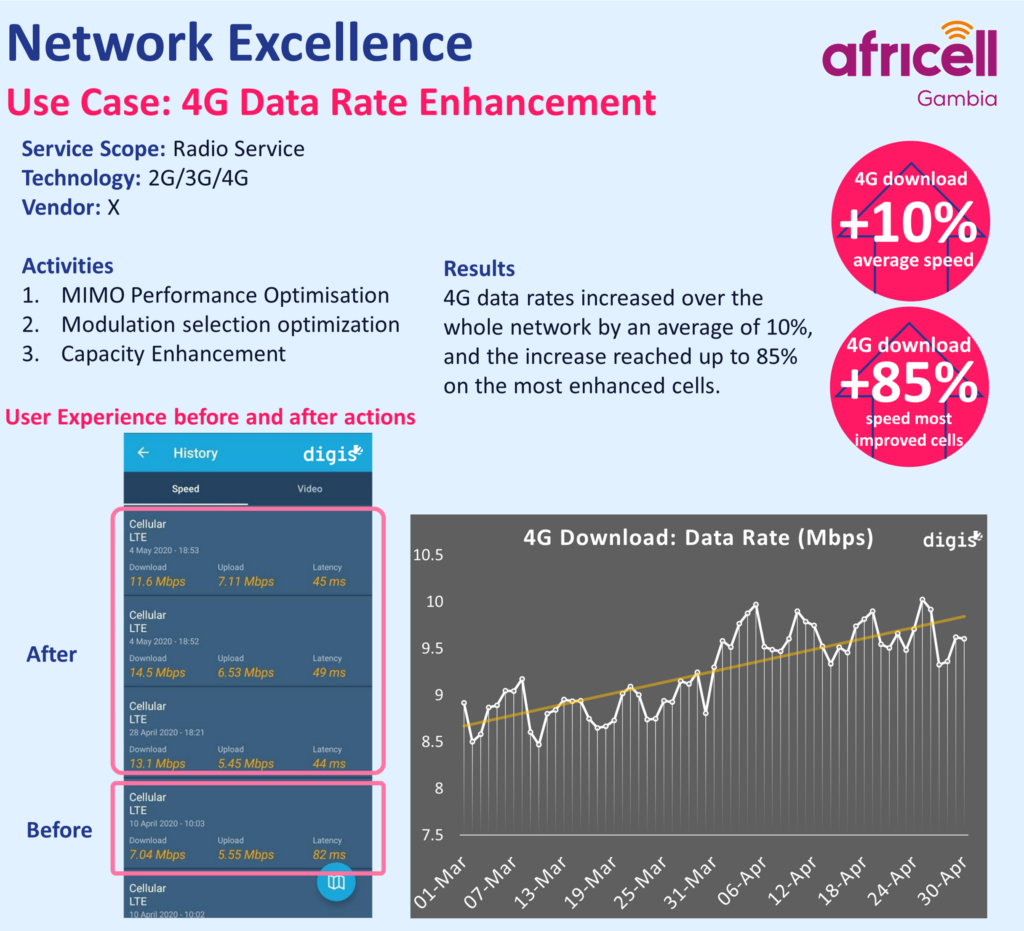
In this case study, Bassel Mashaka, RAN Senior Manager at Africell Group, and Ahmed Ma’moon, Digis Squared’s Account Manager for Africell Group, describe how Africell’s mobile networks were optimised remotely and safely during the Covid-19 pandemic. They share details of the cooperation within Radio, Field Optimisation and Core Optimisation Services, that were successfully delivered in 2020 – including +85% improvement in mobile data downlink throughput in most improved cells – and talk about the expanded scope of the teams’ collaboration in 2021.

Africell, one of the fastest-growing mobile operators in Africa

Africell provides voice, messaging, data, mobile money and other integrated telecoms services to over 12 million subscribers in 4 countries. It has over 60% of the market in Sierra Leone and The Gambia, and up to a quarter of the market in Democratic Republic of the Congo (including in Kinshasa, the capital city). In January 2021 Africell won a competitive international tender process for a telecommunications license in Angola, and has announced a target to launch services in Angola by the end of 2021.

Optimising Africell mobile networks remotely during Covid-19

At the start of 2020, as the pandemic struck, workers and students had to rapidly adjust to working from home where possible. Mobile data demand shifted in new and unpredictable ways and mobile network operators and service providers had to sprint to keep up.

Ahmed Ma’moon reflects on this time: “It was at the start of Q2 of 2020 that Digis Squared was selected by Africell Group to undertaken network optimisation work. When talking with Bassel Mashaka about how to confront the challenge, we appreciated the Africell team’s willingness to collaborate and consider new ideas – including undertaking the network optimisation work remotely, using Digis Squared’s cloud-based tools, putting an unprecedented emphasis on health and safety.”

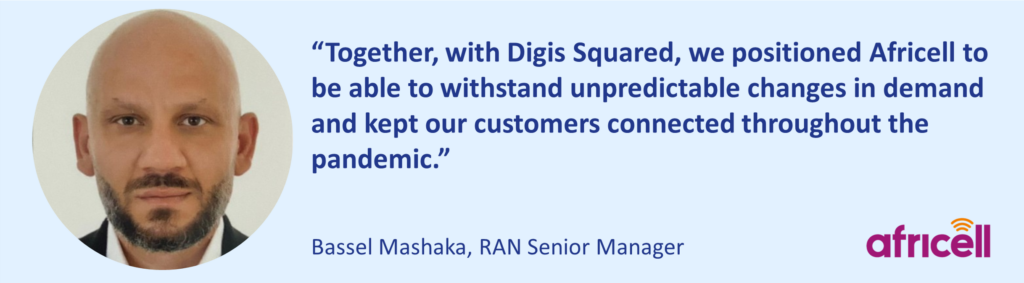
Bassel Mashaka recalls, “The optimisation work we completed with Ahmed and the Digis Squared team ensured we could support our customers as normal working patterns were turned inside out and efficient digital communication between family and friends became more important than ever. The teams worked quickly and unfussily to optimise our networks’ performance. Together, with Digis Squared, we positioned Africell to be able to withstand unpredictable changes in demand and kept our customers connected throughout the pandemic.”
Case study ◦ Optimising Africell mobile networks during Covid-19, safely and remotely

Ahmed shares more about the early stages of the project: “Following previous work we had undertaken for Africell, and the early achievements in terms of network performance and customer experience, Africell awarded Digis Squared contracts for band re-farming and frequency planning services. This new project was focused on two operations, where we worked on preparation ahead of LTE expansion.”

“Working safely and remotely, the Digis Squared team delivered an over-achievement in the band re-farming service in Sierra Leone. Our team were able to re-farm more bandwidth than the planned portion without affecting the re-farmed band.”

“Driven by the successful co-operation between the two business in Radio Services, Africell then mandated Digis Squared to work on the Core Network Optimisation Service in Sierra Leone. Throughout, we also undertook targeted activities to improve network capability.”

“The Digis Squared achievements in 2020 were acknowledged by the Africell Teams and Senior Management in Radio and Core Domains”, Ahmed says. “We are pleased that this hard work led to the renewal and expansion of the network support services contracts for 2021, covering Radio Optimisation, Field Testing and Optimisation, and Core Optimisation.”
Mohamed Hamdy, Chief Commercial Officer at Digis Squared added, “The technical success that the Digis Squared team has delivered for the Africell Group is a great example of the type of collaborative, and long-term relationships our teams build with partners. I’m proud to look back on how their expertise, combined with perseverance during pandemic and cloud-based Digis Squared tools ensured that we could remotely deliver these achievements for Africell, and help them to ensure their customers and communities remained connected.”

In conversation with Bassel Mashaka, RAN Senior Manager at Africell Group, Ahmed Ma’moon, Digis Squared’s Account Manager for Africell Group, and Mohamed Hamdy, Chief Commercial Officer at Digis Squared.

If you or your team would like to discover more about our mobile network optimisation capabilities, please get in touch: use this link or email sales@DigisSquared.com .

Keep up to speed with company updates, product launches and our quarterly newsletter, sign up here.

Digis Squared, independent telecoms expertise.

Abbreviations

  • CQI Channel Quality Indicator
  • CSP Communications Service Provider
  • DCS Digital Cellular System (GSM-1800)
  • DL downlink
  • DRC / RDC   Democratic Republic of the Congo / République démocratique du Congo

Image credits

Intel case study | Video & TCP optimisation for Tier 1 MNO

As mobile data usage continues to increase globally, it becomes ever more vital to ensure that mobile network infrastructure is optimised to maximise data throughput efficiently and continue to deliver excellent customer Quality of Experience. This case study looks at some recent System Integration work Digis Squared delivered to a Tier One Operator in the Middle East, which achieved over 30% improvement in mobile data downlink throughput.

Data growth – why optimisation will always be vital

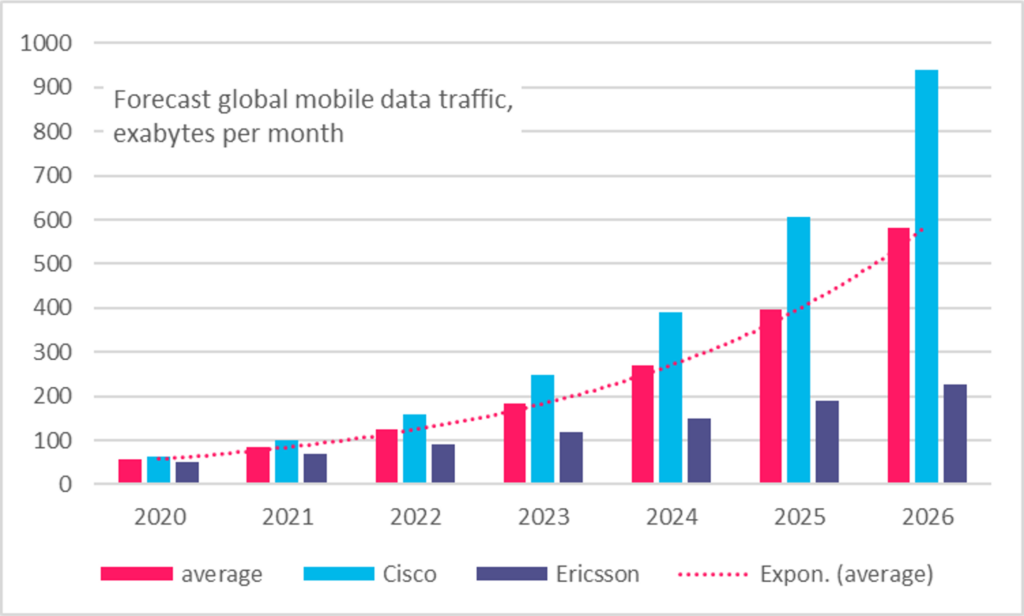
Forecasts of mobile data growth are based on difficult to imagine numbers: exabytes.
1EB = 1 exabyte = 1000000000000000000 bytes = 1,000 petabytes = 1 million terabytes = 1 billion gigabytes


Digis Squared comparison of global mobile data traffic forecasts, source data [1] and [2]

Whilst mobile data forecasts vary significantly – in the data set shown above, Ericsson and Cisco have a 75% variance in their 2026 forecasts – it is clear that mobile data traffic will increase significantly in the next 5 years.

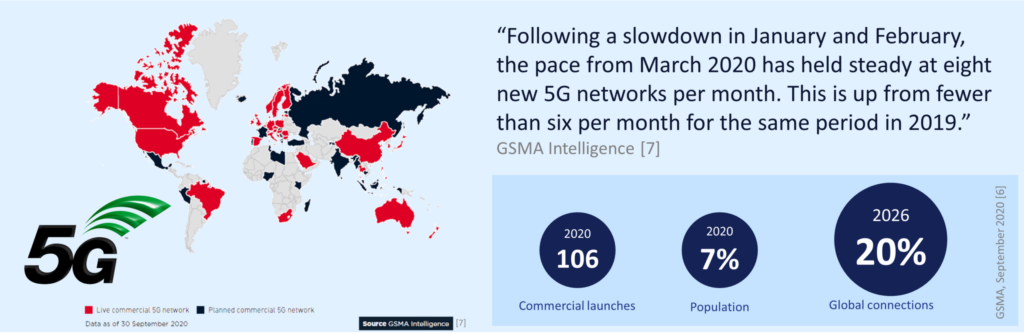
With over 106 5G network launches so far globally [5], 5G is forecast to account for as many as 1.2 billion connections by 2025 [6], and the GSMA estimate over 20% of these mobile connections – a substantial amount of this mobile data traffic – will be carried over new 5G networks by 2026.


Global 5G network rollout, [5] [7]

Data varies by source, but today video traffic is estimated to account for over 60% of all mobile data traffic, and some forecasts project it will increase to 77% by 2026 [1]. Therefore, the ability to optimise mobile data traffic, particularly for video usage, is of great importance to Communication Service Providers (ComSPs), and this is primarily achieved via the optimisation of TCP.

Video & TCP optimisation: vital for delivering excellent customer QoE

Transmission Control Protocol (TCP), is the key transport protocol for all internet traffic; it drives video streaming, file transfers, web browsing, and communications. Additionally, it establishes and manages traffic connections and congestion, handles transmission errors, and enables us to share resources with billions of connected devices, globally, simultaneously.

TCP is ever-evolving, to address new issues and continually improve optimisation as new technologies are deployed. Without efficient tuning, TCP can cause more optimisation issues than it solves. An optimised TCP implementation delivers increased goodput (lower error rate in data throughput), improved network efficiency, high TCP transfer speeds, lower retransmission rates, and more consistent TCP round-trip times – and who doesn’t want all of that?! All of this translates into improved Quality of Experience for customers, and as our expectations of device experience continue to rise, TCP becomes ever more vital.

With mobile data traffic rising exponentially, the increasing pace of 5G deployment, and growth in data-intensive video calls, video content and online gaming, the need for CSPs to optimise their network has never been greater.

Intel case study | Video & TCP optimisation for a Tier One Operator in the Middle East

In 2020 Digis Squared was selected by a Tier One Operator in the Middle East to manage the entire System Integration of end-to-end services and implementation for video and TCP optimisation on top of the packet core, over 3 core sites.

The solution implemented by the Digis Squared team was built with compute resources utilising 2nd generation Intel® Xeon® Scalable processors.

Yasser ElSabrouty, Digis Squared Co-Founder and System Integration Business Unit Director, explained that “Selecting Intel processors ensured we could confidently deliver the performance and reliable scalability that is vital for efficient and demanding TCP optimisation.  Customers’ expectations of QoE continue to escalate. The pandemic has normalised video interactions far faster than any forecast. We are all experiencing more video calls for communication to mitigate lack of in-person interactions with friends, family, clients and colleagues due to lockdowns and changed working practices. Plus, there is far greater use of video on social media and content platforms as we try to alleviate boredom and entertain each other. As 5G rolls out, people will expect continued improvements – buffering, patchy connectivity, dropped video calls all immediately impact network reputation. Maintaining efficient and optimised TCP requires solutions built on expertise, investment and the right equipment.”

“Working for this Tier One client, the Digis Squared team project managed the integration of this solution, selecting and managing vendors, implementing all elements of hardware and software, and optimising the solution to deliver the maximum efficiencies across the data network.”

“The project delivered considerable benefits to the client, and end customers. The Digis Squared project team benchmark data measured,

  • a 27% increase in processing cores [3]
  • 50% increase in bandwidth over previous generation Xeon processors [3]
  • 30% down link throughput enhancement, thanks to the data traffic optimisation achieved. [4]

We’re really proud of what we’ve been able to achieve for this client, knowing that their end-users will benefit from improved QoE that they can really see.”

In conversation with Yasser ElSabrouty, Digis Squared Co-Founder and System Integration Business Unit Director.

This article appeared first on the Intel Network Builders blog.

Additionally, it is available as a stand-alone white paper here.

If you or your team would like to discover more about our System Integration capability, video and TCP optimisation, or other elements of mobile network optimisation, please get in touch: use this link or email sales@DigisSquared.com .

Keep up to speed with company updates, product launches and our quarterly newsletter, sign up here.

Digis Squared, independent telecoms expertise.

Sources

  1. Ericsson: Mobile data traffic outlook
  2. Researchgate (Cisco)
  3. Dell EMC Spec Sheet
  4. Digis Squared project data (first published in this blog post)
  5. GSMA Future networks
  6. GSMA Future networks
  7. GSMA Intelligence Global Mobile Trends 2021 Report

Abbreviations

  • CSP Communications Service Provider (ComSP)
  • EB exabyte = 1000000000000000000 bytes = 1,000 petabytes = 1 million terabytes = 1 billion gigabytes
  • TCP Transmission Control Protocol

Image credits

  • Digis Squared social media and blog banner image: Linda K Nicely
  • The Intel® Network Builders logo and graphics are copyright and trademark Intel.
  • The “digis2” logo is copyright and trademark Digis Squared Limited.