The Road to 6G: Engineering Breakthroughs in the Terahertz Spectrum

While the theoretical possibilities are exciting, I’ve learned throughout my career that theory represents only one side of the equation. On the other side lies reality: signal loss, energy constraints, component limitations, and the unforgiving properties of our atmosphere. Today, I want to examine the engineering challenges that 6G must overcome to transform its spectral ambitions into practical, deployable technology.

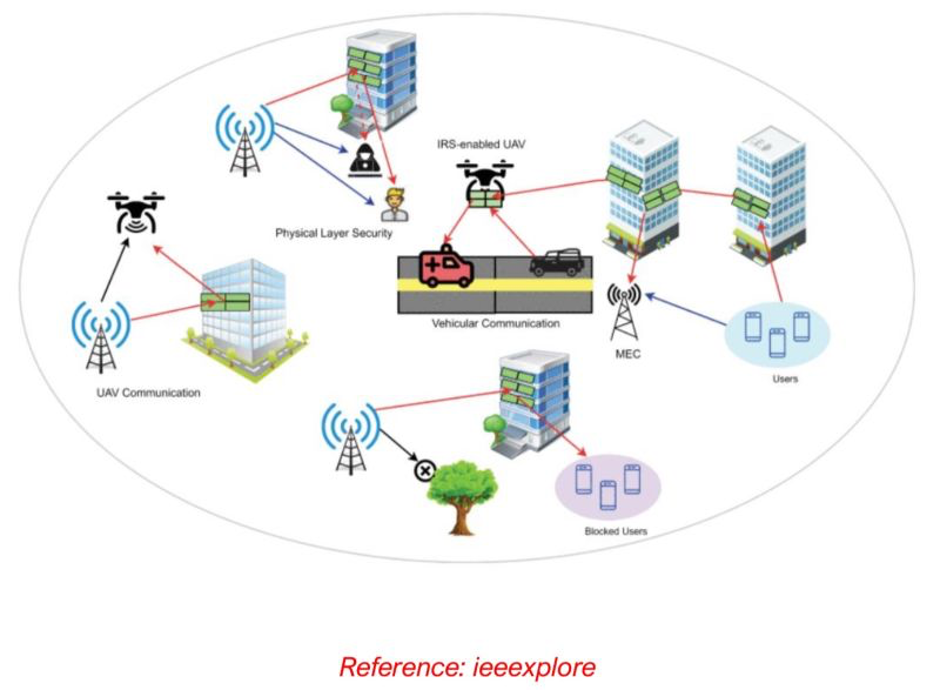
Perhaps the most fundamental challenge we face is propagation loss. As frequencies increase, free-space path loss grows exponentially, a physical reality that cannot be engineered away. At 100 GHz, signal attenuation is already substantially higher than in traditional 5G bands. By the time we reach 1 THz, even a few meters of distance can drastically degrade signal strength. This isn’t merely an inconvenience; it fundamentally reshapes how we must approach network architecture. 6G will require advanced beamforming techniques, ultra-short-range cells, or reconfigurable intelligent surfaces (RIS) just to maintain basic communication links at these frequencies.

Atmospheric absorption presents another significant hurdle. In sub-THz and THz ranges, atmospheric gases—particularly water vapor and oxygen absorb electromagnetic waves in ways that create distinct challenges for wireless communication. Absorption peaks occur at specific frequencies: 183 GHz for water vapor and 325 GHz for oxygen, effectively creating “spectral dead zones” where long-range communication becomes impractical. Our strategy must therefore focus on identifying and utilizing transparency windows (such as 140 GHz) for viable communication links, while allocating other frequency bands for indoor or ultra-dense deployment scenarios where atmospheric effects are minimized.

The hardware requirements for THz communication represent perhaps the most immediate practical challenge. Today’s RF integrated circuits and front-end modules simply weren’t designed for terahertz operation. Silicon CMOS technology, the workhorse of modern wireless systems, begins to hit fundamental performance limits beyond 200 GHz. Alternative semiconductor technologies like Gallium Arsenide (GaAs) and Indium Phosphide (InP) show promise but remain expensive and less amenable to mass production. Beyond the semiconductors themselves, waveguide components, antennas, and packaging become highly lossy and mechanically delicate at these frequencies. Innovation pathways include hybrid integration approaches, nanophotonic technologies, plasmonic antennas, and metamaterials, all of which require substantial research investment before commercial viability.

Power efficiency emerges as another critical bottleneck. Power amplifiers operating at THz frequencies currently suffer from poor efficiency, generating excessive heat while delivering limited output power. In battery-constrained mobile devices, this inefficiency could render many theoretical applications impractical. Addressing this challenge will require multifaceted approaches: AI-driven energy management systems, novel energy harvesting techniques, and beam-aware hardware designs that minimize power consumption when full-power transmission isn’t necessary.

Precision timing and synchronization take on new importance at these frequencies. With the ultra-short wavelength characteristic of THz signals, even nanosecond-level timing errors can destroy link integrity. This impacts not just data transmission reliability but also the accuracy of sensing and positioning applications that 6G promises to enable. Meeting these requirements will demand high-stability clock sources, potentially including quantum timing references, and integrated sensing-transmission designs that maintain phase coherence across multiple functions.

The testing and simulation infrastructure for THz systems remains underdeveloped. Existing RF testbeds rarely extend beyond 100 GHz, creating a gap between theoretical models and practical verification. Simulation models for THz propagation are still evolving, and standards for THz-specific channel models are under development but not yet finalized. Without robust tools for repeatability and comprehensive test systems, mass deployment of THz technology remains speculative at best.

Finally, ecosystem fragmentation presents a strategic challenge. Unlike 5G, which benefited from relatively rapid ecosystem convergence around specific bands and technologies, 6G’s spectral frontiers are being explored in different frequency ranges across various countries and research institutions. Technical definitions and key performance indicators lack harmonization, and mainstream OEM and chipset vendor roadmaps have yet to fully incorporate these advanced frequency bands. This fragmentation could slow development and increase costs unless addressed through coordinated international efforts.

Despite these formidable challenges, I see tremendous beauty in the struggle to overcome them. These obstacles aren’t roadblocks; they’re invitations to innovate in ways that will transform not just telecommunications but multiple scientific and engineering disciplines.

The development of 6G will require an unprecedented fusion of telecommunications engineering, quantum physics, and materials science. Those who successfully bridge these domains will lead the industry forward not just in products and services, but in establishing entirely new paradigms for how we understand and utilize the electromagnetic spectrum.

As we navigate these challenges, I believe we’ll discover that the limitations imposed by physics aren’t constraints but catalysts forcing us to think more creatively, collaborate more effectively, and ultimately develop solutions that extend far beyond telecommunications into healthcare, environmental monitoring, security, and countless other domains that will benefit from mastery of the terahertz frontier.

This blog post was written by Head of Products, Mohamed Sayyed, at Digis Squared.
Why 6G Spectrum Matters: The Invisible Anchor of the Next Wireless Revolution

As I reflect on the trajectory of mobile communications, I find myself at a fascinating inflection point. We stand at the threshold of another major leap forward, and the promise of 6G extends far beyond incremental improvements in speed or latency. What truly excites me is how 6G represents a fundamental reimagining of how intelligence, presence, and connectivity converge in our networks and devices. At the core of this transformation lies an often overlooked but absolutely critical element: spectrum.

I’d like to explore why spectrum will once again shape not just our networks, but our societies and the very fabric of our digital existence.

Each generation of wireless technology has been defined by the spectrum it unlocked. 3G introduced us to mobile internet, fundamentally changing how we access information. 4G gave birth to the mobile economy, enabling video streaming, social media, and real-time applications that have transformed business models and social interactions. 5G pushed into millimeter wave frequencies, delivering industrial-grade responsiveness for critical applications.

But 6G represents something more profound. The leap isn’t merely technological—it’s philosophical. Connectivity is evolving to become contextual and cognitive. Our networks won’t just react to demands; they’ll anticipate needs. Devices are transforming from communication tools into intelligent sensors and agents that understand and interact with their environment. To enable this vision, 6G will require access to new spectral frontiers, particularly the sub-terahertz and terahertz (THz) ranges that have remained largely untapped for communications.

The relationship between spectrum and 6G innovation is multifaceted and critical. First, we face the fundamental challenge of data hunger meeting bandwidth bottlenecks. Applications like immersive extended reality, holographic communication, and digital twins demand terabit-per-second scale bandwidth capacities that can only be provided through the vast, underutilized frequency bands far above today’s cellular allocations.

Second, moving into terahertz bands introduces entirely new physics to our communication systems. This isn’t just about higher speeds; it means fundamentally different signal behaviours, novel hardware challenges, and revolutionary ways of sensing the environment. The properties of these frequencies will enable capabilities we’ve barely begun to imagine.

Third, spectrum is increasingly becoming a strategic national resource. The countries and companies that shape the 6G spectrum narrative will effectively shape the rules of digital engagement for the next decade and beyond. This geopolitical dimension adds another layer of complexity to spectrum allocation and standardization.

As we develop these new frequency bands, we’ll need new ways to describe and categorize them. Just as 5G required a new “language” to describe its frequency bands (such as n78 or FR2), 6G will demand new spectrum notations to handle wider bandwidths (tens or hundreds of gigahertz), account for dynamic spectrum sharing and AI-managed allocation, describe multi-layered integration across space, air, and terrestrial networks, and reflect new use-case mappings for sensing, localization, and environmental feedback.

Without clear and intelligent spectrum notations, we risk fragmenting the global 6G conversation—both technically and geopolitically at precisely the moment when unified approaches are most needed.

We often discuss spectrum in abstract terms as an invisible field of energy we harness for communication. But the spectrum has language. It has a notation. And as we transition from 5G into the far more complex realm of 6G, that language is evolving in significant ways.

To understand the future of wireless, we must first understand how we describe it. At the most basic level, frequency measurements tell us about radio wave oscillation: 1 Hz represents one cycle per second, 1 MHz is one million cycles per second, 1 GHz is one billion cycles per second, and 1 THz is one trillion cycles per second. Higher frequencies oscillate faster, enabling more data to be carried per unit time but also introducing greater signal loss, narrower coverage, and new technical challenges.

The evolution of mobile communications has consistently moved toward higher frequencies: 2G operated in hundreds of MHz, 4G and early 5G exploited sub-6 GHz bands, 5G NR expanded into millimeter wave (24–100 GHz), and 6G will push from 100 GHz to potentially 10 THz. This progression reflects our growing appetite for bandwidth and the technological innovations that make higher frequencies viable for communication.

In 5G, standardized notations were introduced to simplify discussions about specific frequency bands. Designations like n78 (3300–3800 MHz, a widely deployed mid-band 5G range) and broader categories like FR1 (sub-6 GHz frequencies) and FR2 (24–52 GHz millimeter wave) have streamlined regulatory, engineering, and operational conversations. However, as we move into sub-THz and THz frequencies, these notation schemes begin to show their limitations.

As we begin to propose bands like 140 GHz, 275 GHz, and even 1 THz for 6G, new spectrum notation systems will be required to unify wider frequency ranges under flexible identifiers, account for hybrid use cases where a single band supports sensing, communication, and computing simultaneously, and enable AI interpretation through machine-readable notations for real-time spectrum management.

We might see notations like fTH1 (Fixed THz Band 1: 275–325 GHz), dTHx (Dynamic Terahertz experimental block), or sT1 (Sensing THz Band 1, dedicated for RF-based environment detection). While these are speculative examples, they illustrate the fundamental need: our notation must evolve alongside our use cases and technology.

The importance of well-defined spectrum notation extends across multiple stakeholder groups. For engineers, poorly defined notation creates confusion in hardware design, simulation, and deployment. For regulators, a lack of harmonized notation leads to regional incompatibility and inefficiencies in global rollout. For innovators, a shared, evolving language opens doors to collaborative research, efficient prototyping, and even machine-to-machine spectrum negotiation.

It’s worth noting that notation isn’t neutral; it embodies power. Whoever defines the language often shapes the outcome. As we collectively create 6G, spectrum notation represents a strategic touchpoint—a bridge between science, policy, and geopolitics that will influence the development trajectory of next-generation wireless technology.

The future of 6G is being written not just in laboratories or boardrooms but in the electromagnetic spectrum itself. If 5G reached into the millimeter-wave frontier, 6G is preparing for a quantum leap into the sub-terahertz and terahertz bands. These frequency ranges, once considered the domain of theoretical physics or space science, are now firmly in the telecom spotlight.

Before exploring specific frequencies, it’s important to understand that 6G isn’t simply “5G, but faster.” It aims to support terabit-per-second data rates for holographic and immersive applications, microsecond-level latency for real-time control and tactile internet, native AI and sensing capabilities embedded directly in the spectrum layer, and multi-dimensional connectivity spanning terrestrial, airborne, and satellite networks. To support these capabilities, we need wider bandwidths than ever before—and that’s only possible at higher frequencies.

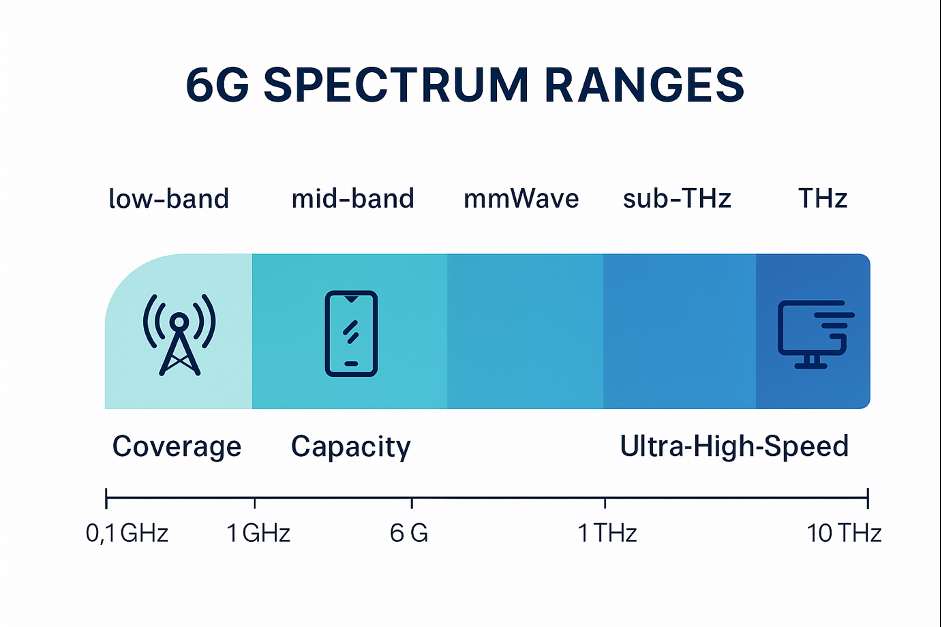
Several spectrum ranges are emerging as candidates for 6G deployment. Upper Mid-Bands (7–24 GHz), sometimes called FR3, offer a potential balance between coverage and capacity for early 6G deployments. Candidate bands in this range include 7–15 GHz, with particular interest in the 10–14.5 GHz range being explored by ITU. These frequencies could support urban macro deployments with extended coverage and decent capacity, though existing satellite usage presents challenges that will require robust coexistence frameworks.

Sub-Terahertz bands (100–300 GHz) represent the range where true 6G performance begins to shine. Particular interest has focused on 100–140 GHz (under exploration in Europe, Korea, and Japan) and 275–325 GHz (proposed as a new THz communication block). These frequencies could enable indoor ultra-high-speed access, device-to-device communications, and real-time augmented, virtual, and extended reality applications. However, they face challenges including severe path loss, line-of-sight requirements, and hardware immaturity.

Terahertz Bands (0.3–10 THz) push beyond traditional RF into new physical domains. These bands, currently under early-stage scientific study, could support wireless cognition, high-speed backhaul, and environmental sensing. The challenges here are substantial: limited current RF integrated circuits, lack of global regulatory frameworks, and energy efficiency concerns.

Low-Band Spectrum (Sub-1 GHz) remains essential even in the 6G era. While not new, these frequencies provide critical coverage for massive IoT, rural areas, and emergency communications. The primary challenge is that this spectrum is already heavily saturated with legacy systems.

International harmonization efforts are underway across multiple organizations. ITU-R (WP 5D) is actively evaluating candidate frequencies for IMT-2030 (the official designation for 6G). The FCC in the United States has opened exploratory windows at 95–275 GHz. Europe’s Hexa-X project advocates for coordinated research into 100+ GHz spectrum. China, Korea, and Japan are conducting field trials at 140 GHz and above. Global harmonization will be crucial—not just to avoid interference, but to enable cross-border 6G roaming, manufacturing scale, and effective spectrum diplomacy.

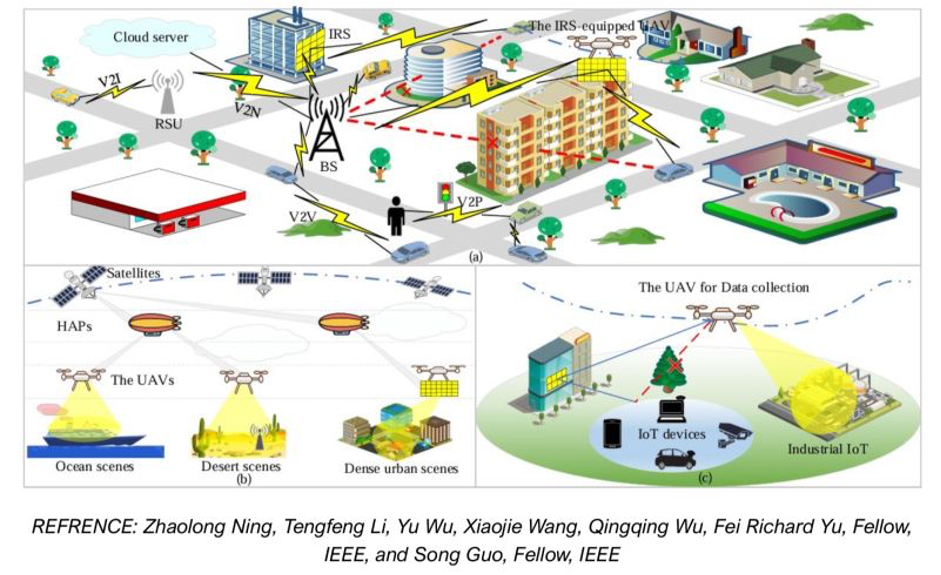
Rather than depending on any single band, 6G will likely employ a layered spectrum approach: low bands for resilient, wide-area coverage; mid bands for urban macro deployment and balanced rollout; sub-THz for immersive services and fixed wireless; and THz for sensing, cognition, and backhaul. All of these layers will be dynamically orchestrated, likely through AI and real-time feedback systems, to create a seamless connectivity experience across diverse environments and use cases.

Author: Obeidallah Ali, R&D Director at DIGIS Squared

Obeidallah Ali leads the Research & Development efforts at DIGIS Squared, driving innovation in AI-powered telecom solutions. With deep expertise in 5G Network Design, Optimization, and Automation, he focuses on developing tools like INOS™ and Katana™ that help operators diagnose, troubleshoot, and enhance network performance worldwide.

For inquiries, please contact:
Email: info@digis2.com

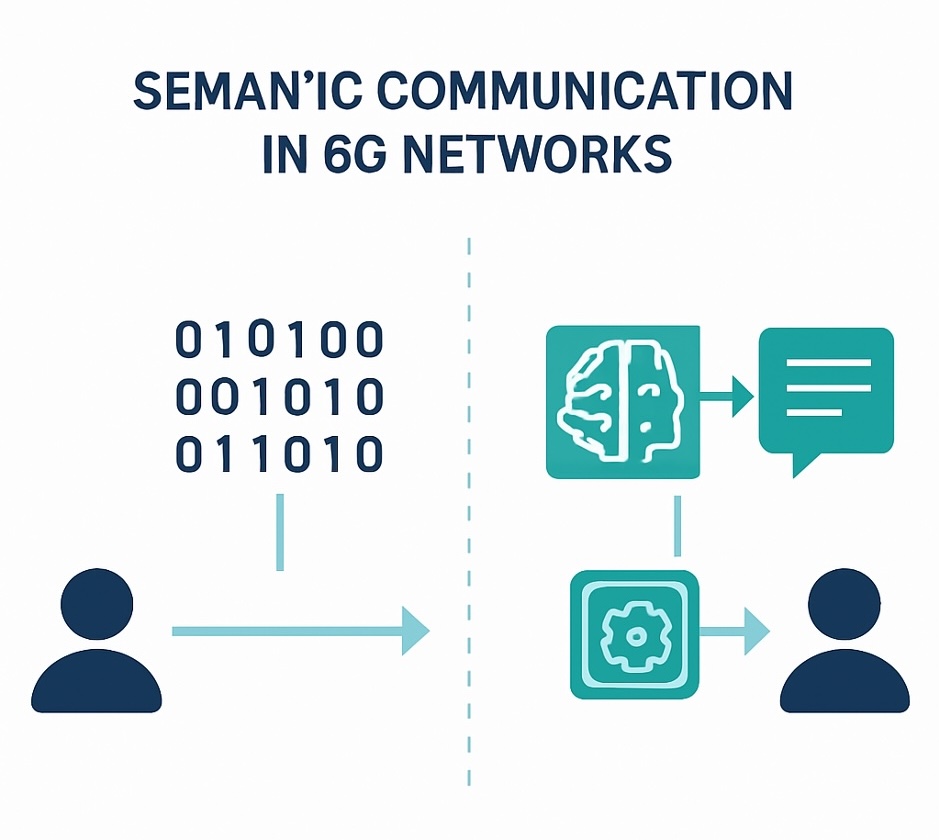
Semantic Communications: Rethinking How Networks Understand Meaning

Traditional communication models, like Shannon’s theory, have always focused primarily on the accuracy of bit transmission from sender to receiver. But in today’s world, dominated by AI, IoT, and immersive experiences, this approach is becoming increasingly insufficient. The challenge isn’t just about transmitting data anymore; it’s about transmitting the right data, with the right context, at precisely the right moment.

At its core, semantic communication represents a model that prioritizes understanding over mere accuracy. Rather than sending every bit of information, semantic systems intelligently transmit only what’s necessary for the receiver to reconstruct the intended meaning. This represents a profound shift in how we conceptualize network communication.

Consider this practical example: a device needs to send the message “I need a glass of water.” In classical communication, this entire sentence would be encoded, transmitted, and decoded bit by bit, regardless of context. But in a semantic communication system, if the context already indicates the user is thirsty, simply transmitting the word “glass” might be sufficient to trigger complete understanding. This approach is inherently context-aware, knowledge-driven, and enhanced by artificial intelligence.

The necessity for semantic communication becomes increasingly apparent when we consider its practical benefits. It substantially reduces redundant data transmission, which conserves both bandwidth and energy, critical resources in our increasingly connected world. For latency-sensitive applications like critical IoT systems, autonomous vehicles, and holographic communication, this efficiency translates to meaningful performance improvements. Furthermore, it enhances machine-to-machine understanding, enabling more intelligent edge networks, while aligning communication more closely with human-like reasoning patterns, making our interactions with technology more natural and efficient.

When we examine these advantages collectively, it becomes evident that semantic communication isn’t merely a beneficial addition to our technological toolkit; it represents a fundamental paradigm shift in communications technology.

The enabler of this transformation is undoubtedly artificial intelligence, particularly in domains such as natural language understanding, knowledge graphs, semantic representations, and the ability to learn shared context between sender and receiver. When integrated with Digital Twins and Cognitive Networks, semantic communication becomes even more powerful, allowing systems to predict, understand, and take proactive action rather than simply reacting to inputs.

At Digis Squared, we view Semantic Communication as a cornerstone of future AI-native networks. I believe it will fundamentally reshape how we design, operate, and optimize telecom systems, not only by increasing efficiency but by making networks truly intelligent.

As Head of Product, I find myself increasingly asking a question that challenges conventional thinking: What if our networks could understand why we communicate, not just what we communicate? This perspective shifts our focus from merely building faster networks to creating smarter, more meaningful ones that truly understand human intent.

Author: Mohamed Sayyed, Head of Product at DIGIS Squared

Intelligent Reflecting Surfaces (IRS)

Paving the Way for 6G Connectivity. As we are only a few years away from the 6G era, one of the transformative technologies shaping the future of wireless communication is Intelligent Reflecting Surfaces (IRS). But what exactly is IRS, and why is it so critical for 6G? Let us dive in.
 
What is IRS?
An Intelligent Reflecting Surface is a planar structure composed of programmable, passive elements (often metasurfaces) that can reflect and manipulate electromagnetic waves. Unlike traditional antennas, IRS is not active device and doesn’t emit or amplify signals. Instead, it reconfigures the wireless environment by dynamically adjusting the phase, amplitude, and polarisation of reflected signals creating an optimized communication pathway between the transmitter(gNB) and receiver
(Handset).
In Real-World Context: Imagine IRS as a “smart mirror” for wireless signals, capable of bending and redirecting communication waves with unprecedented precision.
 
IRS Architecture
IRS typically consists of three key components:
Metasurface: Comprising numerous sub-wavelength elements, each capable of independently tuning the reflected signal.
Controller: A central unit that dynamically configures the metasurface based on real-time channel conditions.
Communication Link: A connection to the base station or network orchestrating the IRS behaviour in response to the environment.
 
Key Advantages Of IRS in 6G:

1- Enhanced Signal Coverage: By intelligently reflecting signals, IRS helps overcome obstacles and dead zones in challenging environments.
2- Noise Mitigation: the reflectors work on noise suppression beside their work on signal amplification
3- Beamforming simplification: with IRS beamforming became much easier than before
4- Throughput improvement: as a direct result of coverage improvement, noise mitigation amd beamforming efficiency improvements the user data rates are significantly better than before.
5- Energy Efficiency: IRS is a passive system, significantly reducing power consumption compared to active communication devices.
6- Improved Spectral Efficiency: By dynamically steering signals, IRS enhances the overall system capacity.
7- Sustainability: Its low power usage aligns with the green communication goals of 6G.
8- CAPEX reduction : boosting the single site coverage will lead to less number of needed sites and consequently this will reduce the overall CAPEX of 6G deployment.

Now let’s see where we can deploy the IRS,
Infrastructure Deployment Locations:
– Buildings and Structures
– High-rise office complexes
– Shopping malls
– Hospitals and healthcare facilities
– Industrial campuses
– Data centers
– Smart city infrastructure

Aerial and Mobile Platforms
– Unmanned Aerial Vehicles (UAVs)
– Autonomous vehicles
– Public transportation systems
– Maritime vessels
– Satellite communication links

Urban and Environmental Contexts
– Streetlamp posts
– Traffic signal infrastructure
– Building facades
– Public transportation hubs
– Underground transit systems
– Bridges and overpasses

Specialized Deployment Zones
– Remote research stations
– Military and defense installations
– Emergency communication networks
– Disaster response infrastructure
– Agricultural monitoring systems
– Renewable energy monitoring sites
 
It is obviously clear that IRS deployment options are diversified and versatile now let’s discuss more the deployment considerations, here you are some Key Factors for IRS Placement:
1- Signal propagation characteristics
2- Environmental obstacles
3- Population density
4-Existing communication infrastructure
5-Cost-effectiveness of implementation
6- Long-term maintenance requirements

Use Cases of IRS
•Urban Connectivity, overcome obstacles in dense urban areas where signal blockage is common.
•Indoor Networks, Boost signal strength in offices, malls, and homes by managing reflections.
•IoT Application, Provide reliable connectivity to low-power IoT devices in complex environments.
•Smart Cities, Enable seamless connectivity for autonomous vehicles, drones, and smart infrastructure.
•Ubiquitous NTN coverage, extension of satellite D2C / D2D coverage and enhance the coverage provided by HAPs
•Terahertz Enablement, by boosting the coverage of extremely high frequency range signals IRS consider as a real enabler for terahertz connectivity.

While promising, IRS technologies are not without challenges:
1- Complex channel modeling requires advanced computational techniques

2- Initial deployment costs can be significant
3- Potential interference issues in dense multi-user environments
4- Ongoing research needed to optimize performance across varied scenarios
5- Mobility managment will be one of the big challenges of IRS deployment
6- Meticulous design and where exactly to deploy the IRS avoiding EHS issues
 
As we embrace 6G, IRS offers an exciting opportunity to reimagine wireless networks. By transforming passive environments into active contributors to communication, IRS isn’t just an enhancement—it’s a revolution.

A 2023 study by Nokia Bell Labs demonstrated IRS can improve network coverage by up to 40% in urban environments, showcasing its transformative potential.

RIS (reconfigurable intelligent surfaces) is an advanced modern form of IRS where in RIS we have the capability to dynamically change the phase and current of the propagated wave in sub-millisecond period

MIT Media Lab Research (2023) developed dynamic metasurface with sub-millisecond reconfiguration, created IRS capable of adapting to changing wireless environments in real-time, reduced energy consumption by up to 60% compared to traditional signal amplification methods.

Prepared By: Abdelrahman Fady | CTO | Digis Squared